Something interesting happened when FX's Love Story aired in early 2026. Searches for "Calvin Klein 90s" spiked 850% in a single week. The RealReal saw Calvin Klein vintage searches jump 139% in the twelve days after the first episode. Shoppers went to the brand's SoHo store looking for the clean, pared-back minimalism they'd seen on screen — and found logoed sweatshirts and graphic tees instead.
The irony is perfect. The aesthetic everyone is searching for — the real Calvin Klein — doesn't exist at Calvin Klein anymore. It exists in the vintage market, where the actual pieces from that era are waiting to be found by people who know what they're looking at.
And at the center of it all is CBK — Carolyn Bessette Kennedy, who didn't just wear Calvin Klein. She was Calvin Klein, in the way that only happens when a person and a brand's philosophy are genuinely aligned.
She wore everything with a classic American sportswear intelligence. She worked for Calvin Klein, so she knew how to draw on the ease and simplicity of it all.
Calvin Klein & CBK — the real story
Carolyn Bessette Kennedy joined Calvin Klein as a saleswoman at the Chestnut Hill Mall in Newton, Massachusetts, fresh out of Boston University. By the time she left the company in 1996, she was director of show productions — having risen through a role handling Klein's most high-profile clients including Annette Bening and Diane Sawyer.
The brand at that moment was at the peak of its cultural power. Klein's minimalism — clean lines, neutral palette, the deliberate absence of ornament — was the defining aesthetic of 1990s American fashion. Employees were expected to wear minimal jewelry, keep makeup understated, dress in monochrome. The brand's philosophy was her daily uniform. It shaped her, and she in turn became its most visible embodiment.
Sunita Kumar Nair, author of CBK: Carolyn Bessette Kennedy, A Life in Fashion, describes her approach as "a deliberate absence of colour" — a Chanel concept that Bessette Kennedy made entirely her own. Black, white, grey, camel. Almost no jewelry. Sunglasses that framed the face without announcing themselves. The effect was of someone who had thought deeply about how to look and then made it appear effortless.
It was at a fitting at Calvin Klein's studio that she first met John F. Kennedy Jr. — a detail that makes the CK connection feel less like employment history and more like the story's setting. The brand wasn't just where she worked. It was where her life changed.
Calvin Klein eyewear — what made it special
Calvin Klein's eyewear line during the 1980s and 90s was manufactured in Italy and Japan to standards that reflected the brand's positioning at the top of American luxury. The frames were designed with the same philosophy that ran through Klein's ready-to-wear: geometric simplicity, quality materials, no unnecessary decoration. A CK frame from this era isn't a logo exercise — it's a piece of considered design that happens to carry the initials.
The current brand doesn't make eyewear with this sensibility. What you find in the vintage market — CK frames from the 1980s through early 2000s — represents the label at its most directional and most carefully made. Italian manufacture, gunmetal hardware, acetate in warm tortoiseshell or clean black. These are the pieces that actually embody the aesthetic CBK represented.
We found six genuine vintage Calvin Klein frames. Here they are.

Tortoiseshell and round — this is the Calvin Klein sunglasses frame that most directly connects to the CBK aesthetic. Bessette Kennedy was frequently photographed in oval and round tortoiseshell frames: understated, warm, making no announcement. This is the frame that disappears into an outfit and makes everything around it feel more considered. At $80, it's the most accessible entry point to genuine vintage CK eyewear on this list — and one of the most wearable shapes for everyday use.
View this find →
The CK 2016 is listed as rare for a reason — this specific model from Calvin Klein's eyewear archive is increasingly difficult to find in good condition. At 54mm it sits at a size that works well for most faces, and the proportions reflect the brand's commitment to clean geometry over trend-chasing. This is the kind of vintage CK frame that serious eyewear collectors look for — a specific model with a known reference number, Italian quality, and the restrained aesthetic that defined the brand at its peak. At $115 it's strong value for a verified rare piece.
View this find →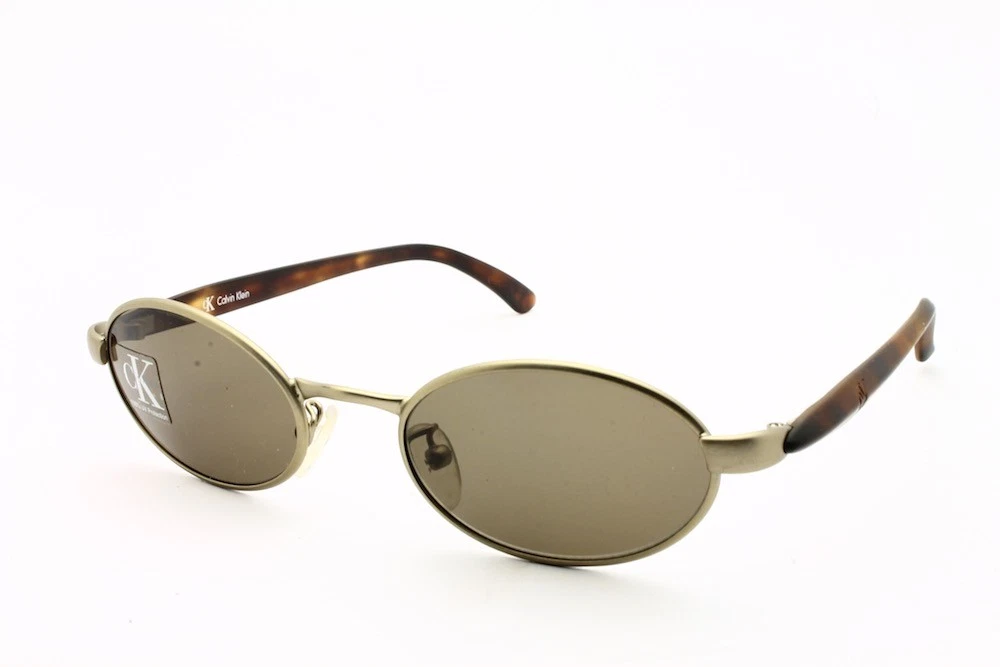
The CK 1010 is one of Calvin Klein's more recognized eyewear references — a frame that appeared throughout the brand's most directional period and embodies its approach to eyewear design: small sizing (50mm lens width), clean geometry, quality construction. The 50-20-135 measurements put this firmly in the vintage women's sizing that CBK herself would have worn — small, precise, face-framing rather than face-dominating. A genuine archive piece from the Calvin Klein eyewear canon.
View this find →
Japanese-manufactured Calvin Klein frames from this era represent a specific tier of quality — Japan's optical manufacturing tradition brought a precision to frame construction that rivaled Italian production. This CK 115 oval frame with its matching clip-on sun lens is a genuinely versatile piece: wear them as optical frames, clip on the sun lens for outdoors. The oval shape connects directly to the CBK-era CK aesthetic, and Japanese manufacture gives them a build quality that rewards looking closely at the hinges and temples. A two-in-one vintage CK find that's hard to improve on at this price.
View this find →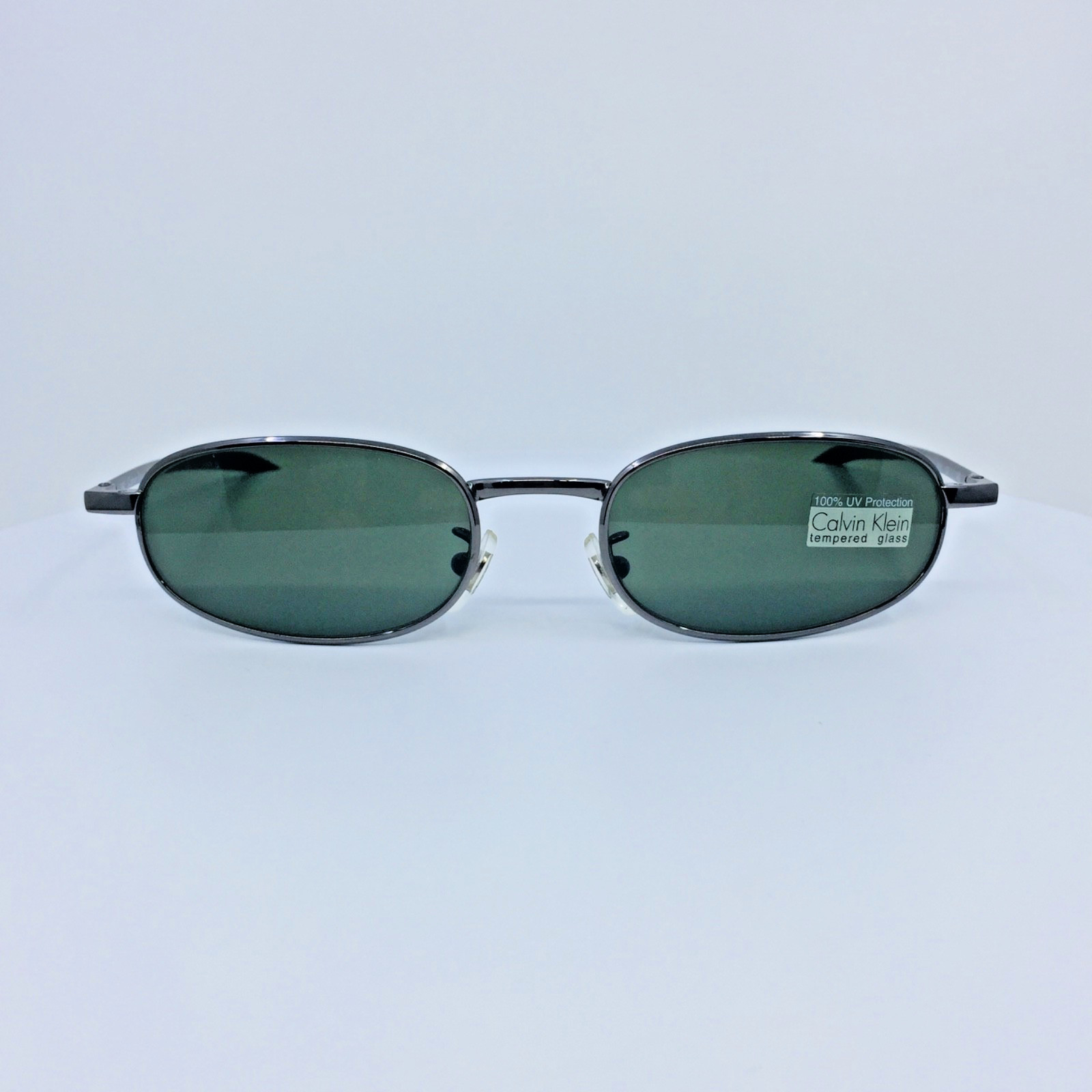
New old stock, Italian made, shiny gunmetal — the CK 157S is a premium piece from Calvin Klein's eyewear archive. Gunmetal is the metal finish that best embodies the brand's 90s aesthetic: not the warmth of gold, not the coolness of silver, but something in between that works with everything. Italian manufacture at this level means forged metal components, precision hinges, and a weight in the hand that modern frames don't replicate. NOS condition means you're getting this exactly as it came from the factory. This is vintage CK eyewear as a serious investment piece.
View this find →
This is the Calvin Klein frame that surprises — the 340S sits at the more directional edge of the brand's eyewear range, with a silhouette that reads as steampunk or indie sleaze depending on how you wear it. It's a reminder that Calvin Klein's eyewear archive wasn't monolithic: alongside the quiet oval frames and the pared-back tortoiseshells were pieces with real visual edge. This is for the person who wants vintage CK but not the obvious CK — someone who understands the brand's range deeply enough to choose something from its more adventurous side. At $250, the most significant piece on this list and the one most likely to appreciate in value.
View this find →How to find genuine vintage Calvin Klein
The surge in interest following Love Story has also brought more replicas and misattributed pieces into the market. A few things to look for when buying vintage CK eyewear:
Genuine vintage Calvin Klein frames will have a model number etched or stamped into the temple arm — CK followed by a number (CK 115, CK 157, CK 2016 etc.). Italian-made pieces will say "Made in Italy" on the temple. Japanese-made pieces will say "Made in Japan." Both represent serious quality. Frames described only as "CK style" or "Calvin Klein inspired" are not the real thing.
The sizing of genuine vintage CK eyewear reflects the era — most women's frames from the 90s are 50–54mm lens width, which reads small by contemporary standards but is precisely the proportion that defines the aesthetic. Going larger defeats the point.
Finally: the current Calvin Klein brand — owned by PVH Corp since 1994 and significantly different from the label CBK worked for — still makes eyewear. But it is not the same product. The vintage pieces above are from the Calvin Klein that shaped Carolyn Bessette Kennedy's world. The brand as it exists now is a different thing entirely.
Browse more vintage eyewear finds on Gem Scouter
Explore the collection →