Vintage sunglasses are one of the most satisfying categories in all of collecting. They're wearable, they're specific to their era in a way that clothes rarely are, and a genuinely good pair — cat eye, oversized, slim wire, mono lens — changes an outfit in a way that almost nothing else can. The right pair makes you look like you know something other people don't.
The challenge is knowing what you're looking at. Every decade had its own silhouette, its own materials, its own relationship to the face. What read as glamorous in 1955 was hopelessly square by 1975. What was futuristic in 2002 is now warmly nostalgic. Understanding the arc of vintage eyewear design is the difference between buying something that feels like a costume and finding something that feels inevitable.
Here's a decade-by-decade guide — what defined each era, what to look for when buying, and a genuine vintage find from each period available right now.
The right pair of vintage sunglasses doesn't announce itself. It just makes everything else make more sense.
The 1950s — The Cat Eye
Before the 1950s, sunglasses were primarily functional — designed to protect the eyes, not define a personality. The postwar economic boom changed that. Hollywood glamour had filtered into everyday life, and women wanted accessories that communicated something. The cat eye was the result: frames with upswept outer corners that elongated and lifted the eye, often in acetate with rhinestone detailing or two-tone coloring.
What to look for in genuine 1950s sunglasses: the hinge placement will be high on the frame, the acetate will have a slight translucency and warmth that modern plastics don't replicate, and NOS (new old stock — never worn) pieces will have a freshness to the finish that immediately distinguishes them. French manufacture was particularly prized, with makers like Swank and smaller regional producers supplying the American and European markets.

NOS — new old stock, meaning never worn — from a French maker, this is the cat eye in its proper form. The upswept frame angle, the scale relative to the face, the quality of the acetate — these are the details that make 1950s sunglasses worth seeking out. French eyewear from this era was made to a standard that the mass market has never since matched. At $60, a genuine unworn piece from this period is remarkable value. The cat eye is having a major revival in 2026 runway collections — this is the real thing those designers are referencing.
View this find →The 1960s — The Mod Frame
The 1960s broke the cat eye's dominance and introduced something entirely new: geometric simplicity. Influenced by the space race, pop art and a general mood of forward-looking optimism, eyewear became cleaner, bolder and more architectural. Frames got more rectangular and square, lenses experimented with tints — pale yellow, light green, rose — and two-tone frames became a signature of the era.
French and Italian manufacture dominated quality eyewear in this decade. NOS pieces from the 1960s are increasingly rare and increasingly coveted. Look for frames marked "Made in France" or "Made in Italy," small sizing (faces were measured differently then — a 52mm lens width would have been considered large), and the particular quality of acetate from this period which has a density and slight variation in color that modern plastic doesn't achieve.

Guinet Suntimer is one of the respected French eyewear makers of the postwar period, and this NOS two-tone small frame is an exceptional example of 1960s eyewear at its most refined. The two-tone acetate — a technique where two colors are layered or fused in the frame material — was a signature of the era, and genuine period examples have a quality of color integration that reproductions never quite replicate. Small framed, French made, never worn. This is the most collectible piece on this list — the kind of find that serious vintage eyewear collectors look for.
View this find →The 1970s — The Oversized Era
The 1970s threw out the geometric precision of the 60s and went large. Lenses grew to cover more of the face, frames got thicker and more expressive, and color became a genuine design element — tinted lenses in amber, purple, rose and green were worn for style as much as UV protection. This was the decade of the aviator's popularization (originally a 1930s military design), the rise of the oversized frame, and the first era where sunglasses were worn without apology as a status symbol.
French and Italian manufacturers led quality production. Maurice St Michel, a French brand with a strong following in both Europe and the American market, exemplified the era's approach: substantial frames, expressive shapes, and a commitment to color. Genuine 1970s oversized frames are identifiable by their weight — they're heavier than modern equivalents — and by the quality of the hinge hardware.

Maurice St Michel oversized frames with purple lenses — this is the 1970s in a single object. The scale of the frame, the color of the lens, the French manufacture: everything about this pair is period-specific in a way that reproductions can't fake. Purple and violet lenses were a particular signature of the era, worn by everyone from rock musicians to film stars. At under $40, this is the most accessible find on this list and also one of the most immediately wearable — oversized vintage frames are one of the biggest eyewear trends of 2026.
View this find →The 1980s — The Power Frame
Where the 70s used size for expressiveness, the 80s used it for power. Frames became architectural — angular, structured, often with strong browlines and thick temples. The decade also saw a return to quality glass lenses in some markets, particularly in Eastern Europe where optical manufacturing traditions remained strong. Real glass lenses have a weight, optical clarity and depth of color that polycarbonate and acetate lenses don't achieve, and they're increasingly sought after by collectors who know what they're looking at.
Soviet-era eyewear from the 1980s represents a particularly interesting collecting category — made to high optical standards, often with real glass lenses, and now surfacing in the vintage market at accessible prices. The aesthetic is utilitarian in the best sense: designed to function brilliantly and built to last.
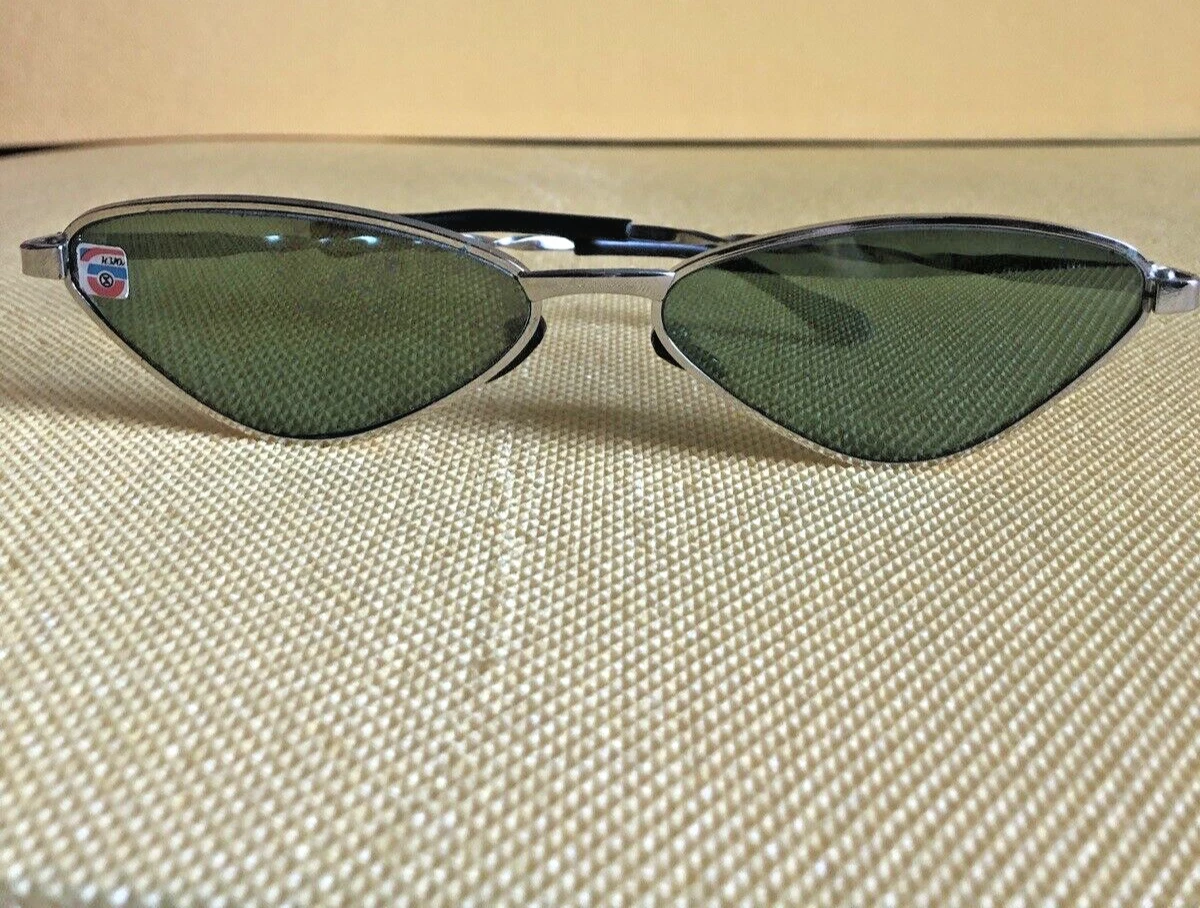
Real glass lenses. This is the detail that sets this pair apart from everything else at this price point. Soviet optical manufacturing in the 1980s was serious — glass lenses ground to optical standards, metal frames built without planned obsolescence. The resulting sunglasses have a clarity, weight and longevity that contemporaneous Western plastic-lens frames simply don't match. These are a collector's find for under $40, and increasingly hard to source in good condition as the supply from Eastern European vintage markets dries up.
View this find →The 1990s — The Slim Oval
After the maximalism of the 80s, the 90s stripped everything back. Frames got smaller and slimmer, shapes went oval and rectangular, and the material palette shifted toward tortoiseshell and warm metals. This was the decade of the wire frame renaissance — thin metal oval frames worn low on the nose, as much a pose as a pair of glasses. Tortoiseshell acetate in warm copper and brown tones became the signature material of the era.
The oval frame is one of the strongest recurring trends in 2026 eyewear — runway collections from multiple major houses are referencing this exact silhouette. The difference between buying vintage and buying a contemporary interpretation is significant: a genuine 90s oval frame has a proportion and weight that the modern versions haven't quite captured.
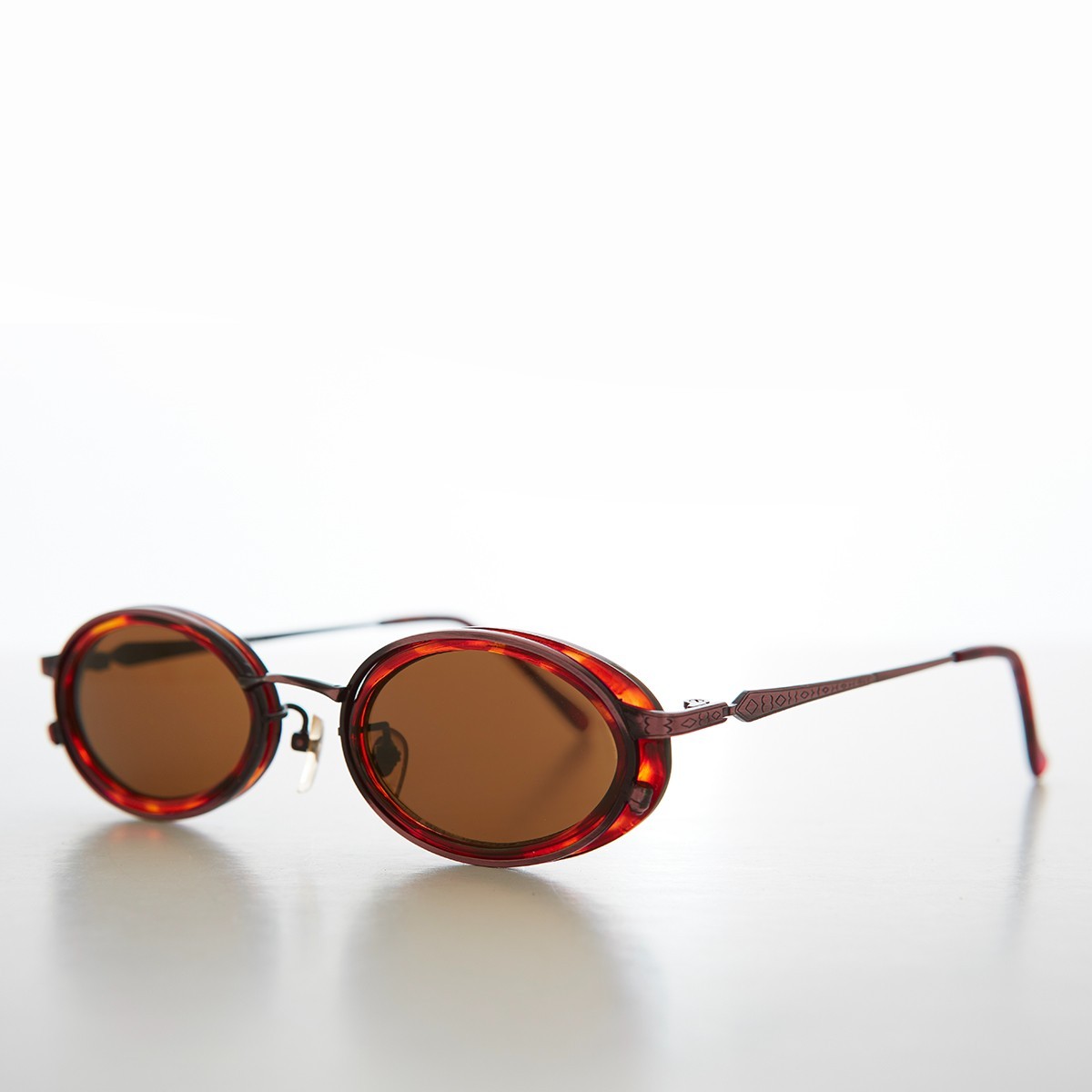
Tortoise copper oval with brown lenses — this is 1990s eyewear reduced to its essential elements. The warm copper tone of the frame against the brown lens creates exactly the earthy, understated palette that defined the decade's approach to accessories. Small, precise, and immediately wearable, this pair works with everything from a minimal wardrobe to a dressed-up evening look. The oval frame is back on every runway right now — this is the vintage original that those designers are drawing from.
View this find →Y2K / 2000s — The Mono Lens
The late 1990s and early 2000s represented a specific moment in eyewear — a deliberate rejection of the minimalism that had defined the 90s, replaced by something louder, more theatrical and increasingly logo-driven. The mono lens (a single uninterrupted lens spanning both eyes, with no bridge) was the decade's most distinctive innovation: architectural, aggressive and immediately recognizable. Designers like Dolce & Gabbana, Versace and Gucci pushed eyewear into pure fashion object territory, making frames that were as much about branding and attitude as vision.
Y2K eyewear is now firmly in the collectible vintage category. Designer pieces from this era — particularly those in good condition with their original cases and authentication — are appreciating. The mono lens specifically is a silhouette with no modern equivalent: nothing currently in production quite captures the combination of oversized scale and single-piece lens construction that defined the best Y2K eyewear.

Dolce & Gabbana's DG 2033 is a genuine piece of Y2K eyewear design — oversized, Italian made, with the single mono lens that defined the era's most directional eyewear. D&G in this period (pre-consolidation, when the brand was still making eyewear with genuine craft attention) produced frames that were built to the same standard as their runway clothing. At $89, a verified vintage D&G mono lens in good condition represents real value — this is the kind of piece that sells for significantly more in specialist vintage eyewear boutiques. The Y2K aesthetic is having a serious cultural moment right now, and the mono lens is its eyewear icon.
View this find →How to buy vintage sunglasses
A few things worth knowing before you buy, regardless of era:
- NOS vs pre-owned — NOS (new old stock) means never worn, usually still with original packaging. It commands a premium but guarantees no lens scratches, no hinge wear, no previous repairs. Pre-owned in good condition is fine, but check photos carefully for lens condition.
- Lens condition — scratches on vintage lenses are usually permanent (unlike modern polycarbonate, vintage glass and acetate lenses typically can't be polished). Look for images taken at an angle to catch surface scratches that straight-on shots miss.
- Frame fit — vintage frames were made for smaller faces on average. If you have a wider face, check the listed measurements carefully. A 52mm lens width is common in vintage but can feel small on a modern face.
- Hinge condition — loose hinges are a common vintage issue. Ask sellers whether hinges are tight. A loose hinge is repairable by an optician but it's worth knowing before you buy.
- Country of manufacture — French and Italian pieces from the 1950s–70s represent the highest quality in vintage sunglasses. "Made in France" or "Made in Italy" markings are a strong indicator of genuine period manufacture.
Browse vintage eyewear finds on Gem Scouter
Explore the collection →